A Ghostfolio alternative that syncs your accounts for you
Ghostfolio is open source and runs on your own server if you want it to. Sonar is hosted: wallets, exchanges and brokerages sync on their own, and every holding shows what the market is saying about it.
Updated October 27, 2026
Ghostfolio is open source wealth management software for tracking stocks, ETFs and crypto. People choose it for privacy and control: you can run it on your own infrastructure under the AGPL-3.0 license, or use its hosted Premium plan. Sonar is a hosted service with a different emphasis: accounts that sync themselves, crypto wallets read by address, and market context on each holding.
What Ghostfolio does well
- Open source. The code is public under AGPL-3.0, with official Docker images for self-hosting. Self-hosted, it's free.
- Your data on your server. Ghostfolio describes itself as for people "valuing privacy and data ownership".
- Transactions you control. Create, edit, import and export transactions, across multiple accounts.
- Performance and risk. Return on average investment including dividends over periods from today to max, charts, and a static analysis of potential risks in your portfolio.
- An API and MCP. A public API for importing and exporting data, and an experimental MCP server, switched on by whoever runs the instance.
- Mobile-first web app. A progressive web app, plus a hosted Premium plan for people who'd rather not run a server.
Ghostfolio suits people who are comfortable entering or importing their own transactions and who value running the software themselves.
Where Sonar is different
- Accounts sync on their own. Wallets on more than 50 networks are read by public address, and on paid plans US brokerages and crypto exchanges connect through Plaid. New trades and balances arrive without an import.
- Nothing to host. Sign in with an email code; there's no server, database or update to look after.
- Social data on every holding. On Starter, each stock and coin you hold shows mentions, engagement, sentiment, social dominance, top creators and news.
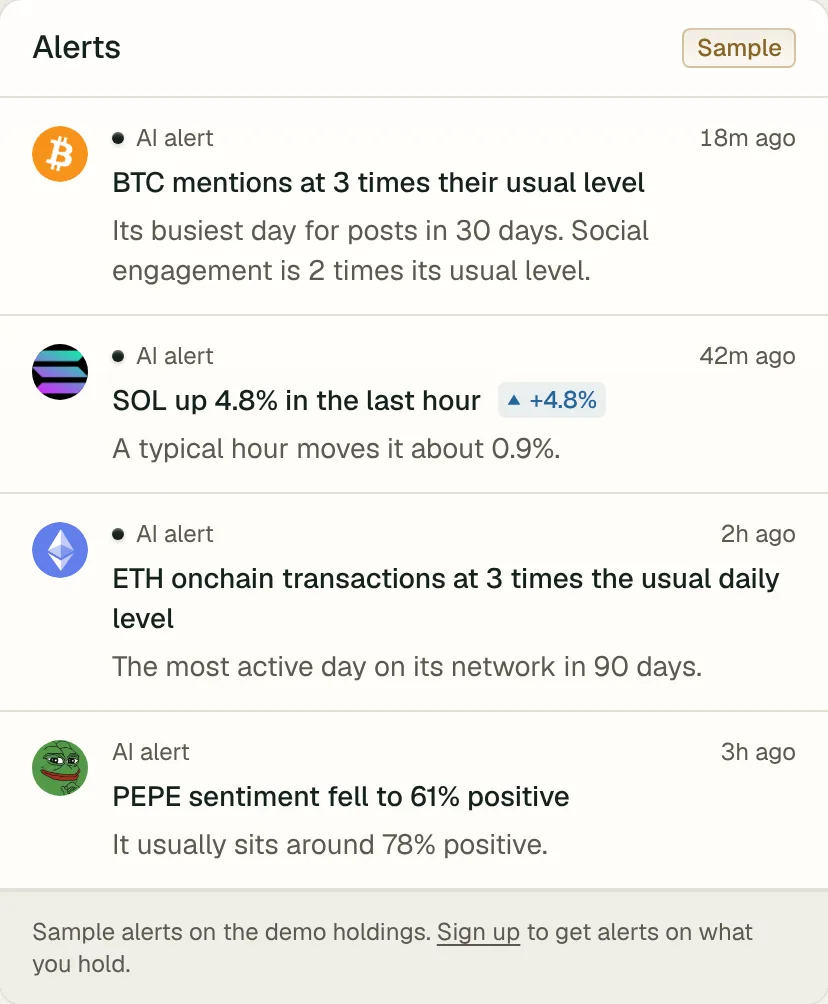
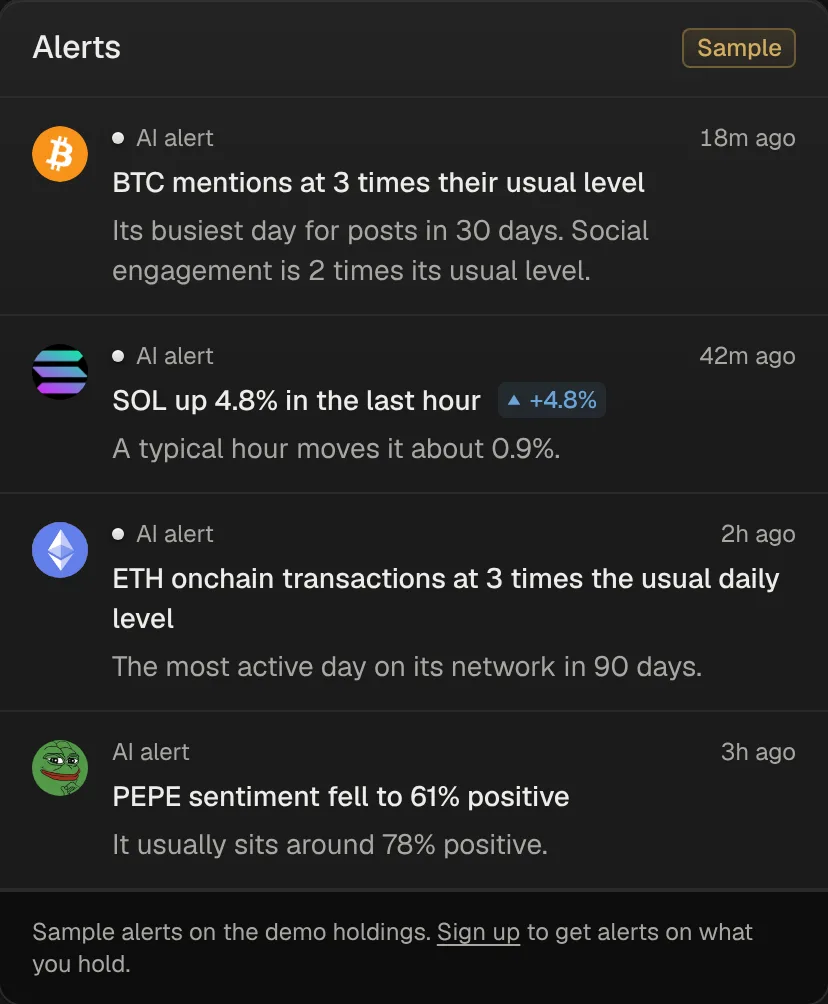
- Onchain data and AI alerts. On Standard, coins show holders, supply concentration and large transfers, and AI alerts flag unusual moves on anything you hold.
- AI access, ready to use. A hosted MCP connector for Claude and ChatGPT, a REST API and a command-line tool, read-only.
Ghostfolio and Sonar compared
| Ghostfolio | Sonar | |
|---|---|---|
| Model | Open source (AGPL-3.0), self-hosted or hosted Premium | Hosted service |
| Cost | Free to self-host; Premium is paid | Free plan; Starter $7, Standard $11, Premium $20 a month |
| Assets | Stocks, ETFs, crypto | Coins, stocks, ETFs, funds and cash |
| Getting data in | Transactions entered or imported | Wallets by address; brokerages and exchanges through Plaid on paid plans; CSV import; manual entry |
| Self-custody wallets | Not listed | Wallets on more than 50 networks |
| Social data on holdings | Not listed | Starter, Standard and Premium |
| AI | Experimental MCP server on your instance | Hosted MCP connector, REST API and CLI |
| Source code | Public | Closed |
When Ghostfolio is the better choice
- You want to run the software yourself and keep every record on your own server.
- You want to read or change the code.
- You're happy to record transactions yourself or import them.
- You want a tool at no cost and can host it.
When Sonar fits better
- You want wallets, exchanges and brokerage accounts to stay up to date without imports.
- You hold crypto in self-custody wallets across several networks.
- You want social and onchain context on each holding.
- You'd rather not run a server. See pricing, or start on the free plan.
How to switch from Ghostfolio
- Get a CSV. Download positions or transactions from each broker, or copy your Ghostfolio activities into a spreadsheet with date, symbol, quantity and price.
- Import into Sonar. Upload the file and check each column before saving; transactions are replayed into today's positions. See importing a CSV.
- Connect what syncs. Paste wallet addresses, and on Starter, Standard and Premium connect exchanges and US brokerages through Plaid, so you don't have to import them again.
Questions
Is Sonar open source?
No. Sonar is a hosted service. Its command-line tool is published on npm.
Is Sonar free like Ghostfolio?
Sonar has a Free plan with no time limit: up to 10 holdings, live prices, performance, CSV import and one connected wallet. Self-hosted Ghostfolio is free with no holding limit.
Where is my data stored?
On Sonar's servers, isolated per user at the database level, with connection credentials encrypted. Nothing is sold. See the security page.
Can Sonar move money?
No. Every connection is read-only.
Ghostfolio is a trademark of its owner. Sonar is not affiliated with Ghostfolio. Facts about Ghostfolio were checked in its public source repository on October 27, 2026, and may have changed since.
Related pages
- Portfolio tracker comparison: 12 apps side by sideCompare portfolio trackers for stocks and crypto: Kubera, Delta, Sharesight, getquin, Empower, Monarch, CoinStats, Snowball and more, with sourced facts.
- Free portfolio tracker for stocks and cryptoSonar's Free plan tracks up to 10 stocks, ETFs and coins with live prices, performance and allocation, CSV import and one connected wallet. No card, no time limit.
- AI portfolio tracker for Claude, ChatGPT and CursorAn AI portfolio tracker with a read-only MCP connector for Claude, ChatGPT and Cursor, plus a REST API and CLI. Ask about your stocks and crypto in plain words.
- Import a portfolio CSV from any broker or appImport holdings or full transaction histories from a CSV. Presets for Koinly, CoinTracker, Delta and Kubera, any broker's export, or rows pasted from a sheet.