How to track asset allocation across crypto and stocks
Measure how your money is split across stocks, ETFs, crypto and cash, spot concentration and drift, and keep an honest view of diversification.
By Sonar team6 min read
To track asset allocation across crypto and stocks, add up the current value of every holding in every account, group them by asset class (stocks, funds, crypto, cash), and divide each group by the total. Then look one level deeper: which single assets are the largest, whether the same asset appears in several accounts, and how far each weight has drifted from the mix you chose. Allocation is only accurate when every account is counted.
This guide explains the concepts, shows how to measure allocation and drift with a worked example, and covers the blind spots that are specific to investors who hold both crypto and stocks. It describes how to measure; what mix suits you is your decision.
Asset allocation, diversification and rebalancing
The SEC's investor education site defines the core ideas in its guide to asset allocation and diversification:
- Asset allocation is how your portfolio is divided among asset categories, such as stocks, bonds and cash.
- Diversification is spreading money among and within those categories so that one investment's losses have a smaller effect on the whole. See also Investor.gov's definition of diversification.
- Rebalancing brings a portfolio back to its original mix, because over time some investments grow faster than others. See the rebalancing definition.
The SEC's Beginners' Guide to Asset Allocation, Diversification, and Rebalancing covers each in more depth.
Crypto adds a category that many traditional guides don't discuss, and it often lives in different apps from your stocks. That's where tracking gets harder.
Step 1: Put every account in one view
Allocation calculated from one app describes that app, not your portfolio. List your brokerage accounts, retirement accounts, exchanges and wallets, and bring them together. See how to track crypto and stocks in one place.
Step 2: Decide how to classify each holding
Classification choices change the result, so make them once and keep them:
| Holding | Common classification | Things to decide |
|---|---|---|
| Individual stocks | Stocks | By region or sector too, if useful |
| Stock ETFs and index funds | Funds or stocks | They hold many companies; count them as diversified |
| Bond funds | Bonds | |
| Bitcoin, ether and other coins | Crypto | |
| Crypto ETFs held at a broker | Crypto exposure | Held at a broker, but the exposure is crypto |
| Stablecoins | Cash-like or crypto | They carry issuer and platform risk that cash doesn't |
| Cash at a broker or exchange | Cash | Include or exclude consistently |
Step 3: Calculate weights
Weight = value of the group ÷ total portfolio value
Do this for:
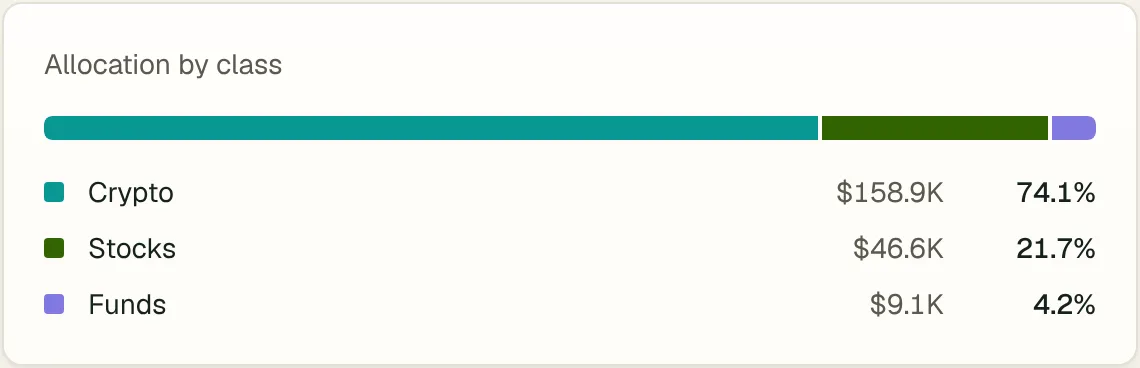
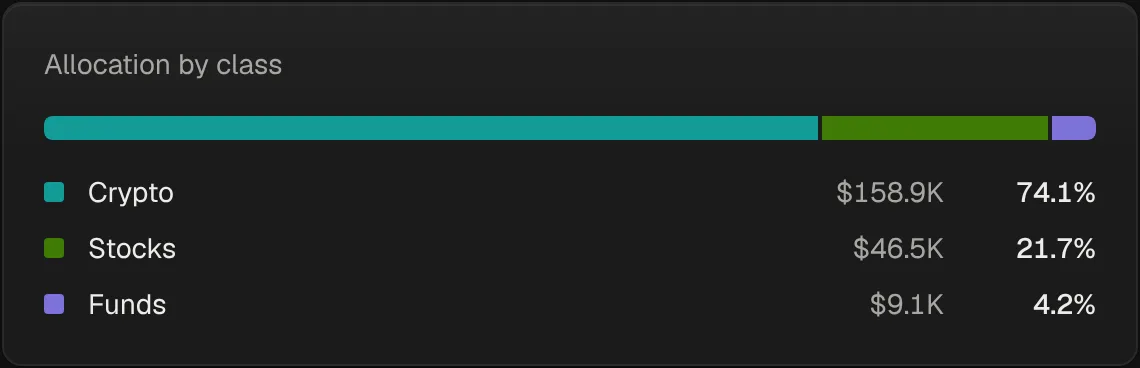
- Asset classes: stocks, funds, crypto, cash.
- Single assets: your largest holdings. The share held by your top three or five positions is a quick measure of concentration.
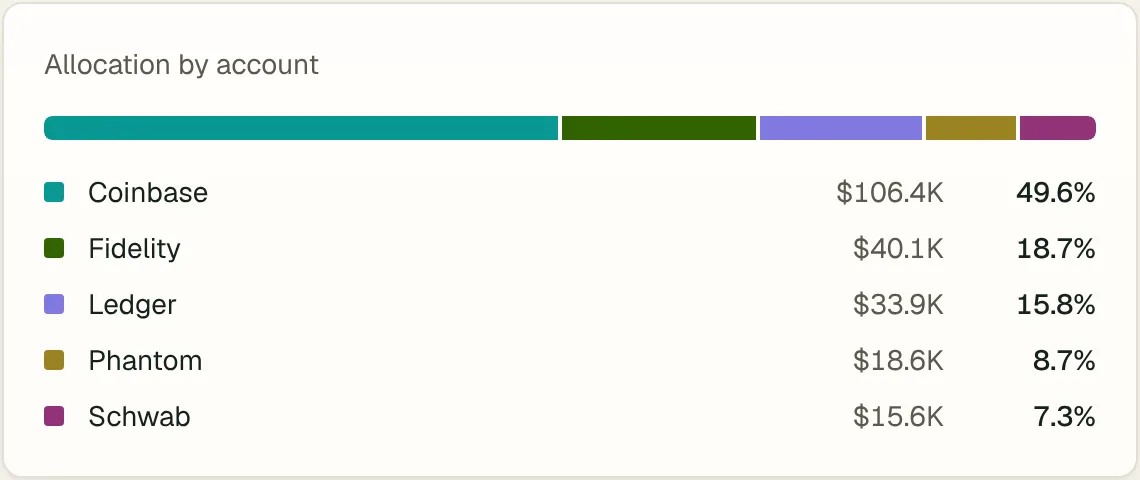
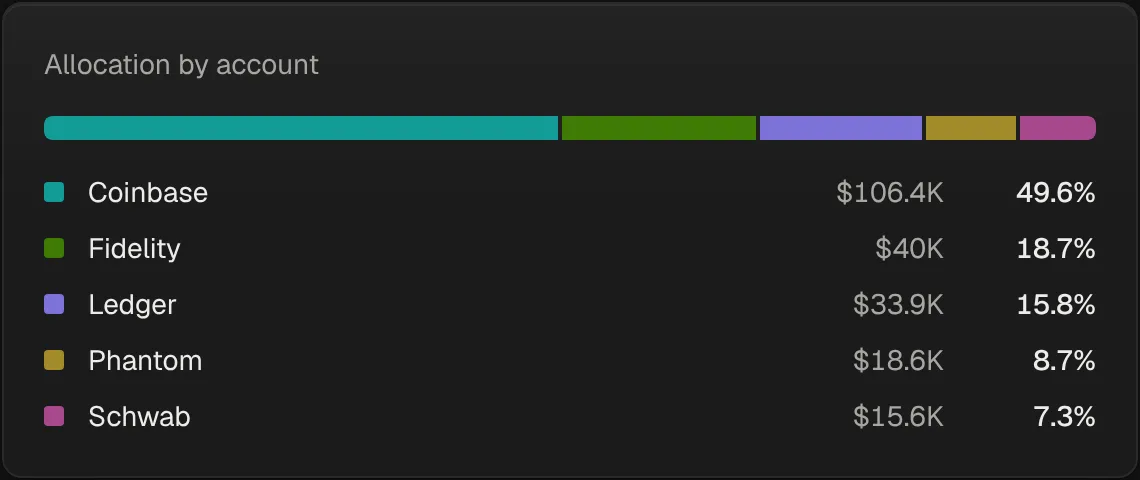
- Accounts: how much sits with each broker, exchange or wallet. This is about platform risk as much as investment risk.
Step 4: Measure drift
Drift is the difference between your current weights and the mix you chose. Assets that rise faster take up more of the portfolio over time, and crypto's larger price swings can make drift happen quickly.
Worked example
This is an illustrative example, not a recommendation. Suppose someone's chosen mix is 80% stocks, 15% crypto and 5% cash, on a $50,000 portfolio:
| Class | Start value | Start weight | Change | End value | End weight |
|---|---|---|---|---|---|
| Stocks | $40,000 | 80% | +5% | $42,000 | 74.3% |
| Crypto | $7,500 | 15% | +60% | $12,000 | 21.2% |
| Cash | $2,500 | 5% | 0% | $2,500 | 4.4% |
| Total | $50,000 | 100% | $56,500 | 100% |
Without any trades, crypto went from 15% to about 21% of the portfolio. That's drift. Whether and how to respond is a personal decision; common approaches include checking on a fixed schedule, acting only when a weight moves outside a band you set, or directing new contributions toward the underweight class. Each approach has trade-offs, including trading costs and taxes.
Blind spots for crypto and stock investors
The same asset in several places
ETH on an exchange, ETH in a hardware wallet and a crypto ETF at your broker can add up to more exposure than any single line suggests. Group by asset across accounts, not just by account.
Diversification by count isn't diversification
Ten coins or ten tech stocks may move largely together. Owning many holdings in one category spreads company- or project-specific risk, but not the risk of the category as a whole. Looking at class weights alongside single-asset weights helps.
Funds hide what's inside
A broad index fund holds hundreds of companies, and some of your individual stocks may already be among its largest holdings. If you own both, your exposure to those companies is higher than your individual positions show.
Platform concentration
A large share of your portfolio on one exchange or with one custodian is a separate risk from what you hold. The account view shows it.
Unpriced or unrecognized positions
If a tracker can't price a token or fund, it may drop out of the totals and make every other weight look larger. Check for positions that aren't recognized.
How Sonar shows allocation
In Sonar, your portfolio page shows allocation by asset and by account across everything you've added: brokerages, exchanges, wallets, CSV imports and manual positions. Click an account to filter your holdings to just that account. Values are converted into the currency you choose, so weights are comparable across platforms.
Positions Sonar can't recognize are kept and flagged rather than silently left out, so you know when a weight might be off. The demo portfolio shows allocation on sample holdings, including a breakdown by class.
On Standard, you can also ask Claude or ChatGPT about allocation through Sonar's read-only connector:
What are my five largest positions, and how much of my portfolio do they make up?
How is my portfolio split between my brokerage and my crypto accounts?
The assistant describes your numbers; what to do with them is your call. See how to use Claude or ChatGPT with your portfolio.
Common mistakes
- Calculating allocation from one account. Count every account, including retirement and old exchange balances.
- Ignoring cash. Cash changes every other weight.
- Classifying inconsistently, such as calling a crypto ETF "stocks" one month and "crypto" the next.
- Forgetting overlap between funds and individual stocks, or the same coin in several wallets.
- Mistaking a rally for a plan. A higher crypto weight after a price rise is drift, not a decision.
FAQ
How do I calculate my allocation between crypto and stocks?
Add up the current value of all crypto holdings and all stock and fund holdings across every account, then divide each by the total portfolio value, including cash if you count it.
Should stablecoins count as cash?
It depends on how you want to see risk. They're designed to track a currency, but they carry issuer and platform risks that cash in a bank doesn't. Many people list them separately from both cash and other crypto.
How often should I check my allocation?
Many people check on a regular schedule, such as quarterly, or when a large price move happens. A tracker updates weights continuously, so checking takes seconds.
Does owning many cryptocurrencies diversify my portfolio?
Within crypto, more coins spread project-specific risk, but crypto assets have often moved in the same direction at the same time. Diversification across asset classes is a separate question from the number of holdings.
Can I track allocation without connecting my accounts?
Yes. Enter positions by hand or import a CSV. Allocation updates as prices change; quantities update when you edit or re-import them.
Related pages
- Crypto and stock portfolio tracker in one placeTrack crypto and stocks together. Wallets, crypto exchanges, US brokerages and CSV imports in one portfolio, with net worth, P&L and allocation by class.
- How to track crypto and stocks in one placeSee stocks, ETFs and crypto as one portfolio. List every account, pick how each one connects, and check that totals and history add up.
- How to calculate your portfolio return (TWR vs MWR)Simple, time-weighted and money-weighted returns explained with worked examples, so deposits and withdrawals stop distorting how your portfolio did.
- ETF portfolio tracker with performance and allocationAn ETF portfolio tracker for index funds across all your brokerage accounts. Time-weighted returns, an S&P 500 comparison, dividends and allocation.